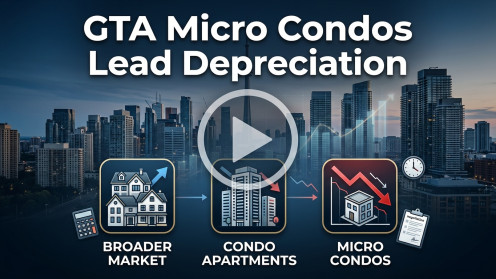
Navigating Toronto’s ever-changing real estate landscape means understanding the nuances behind the numbers. In mid-Q3 2026, the GTA’s average home selling price landed at $993K—a dip of about 3% year-over-year, signaling a continued easing that has tipped the scales in buyers’ favor. Condo apartments, averaging $618K, also saw a decline from the previous year, but it’s the micro condos—those under 500 sq-ft—that faced the steepest challenge. These compact units have become the hardest to sell, as more buyers look for greater space and flexibility. In early Q3, nearly 98% of GTA neighborhoods (with at least five condo sales) saw units go for less than asking, opening up rare negotiating opportunities for active buyers. Single-family homes also experienced underbidding in about 92% of neighborhoods, but the condo market has proven more sensitive with investors stepping back and certain units lingering on the market. Having worked with everyone from newcomers to seasoned investors, I know firsthand how market shifts like these can shape your next move. My approach—rooted in patience, clarity, and a genuine curiosity about people—aims to help you make sense of these trends, whether you’re considering your first home, upsizing, or exploring investment opportunities.
Blog
-
Toronto Rents Fall as Larger Units Rise
Rental trends in Toronto are always interesting to follow—especially when the numbers reveal some unexpected shifts. By mid-Q3, the average asking rent in Toronto had dipped to $2,571, which is about 2% lower than last year. This continues a multi-year pattern of declining overall rental costs. But here’s what caught my eye: larger units are bucking the trend. Three-bedroom apartments saw rents rise approximately 4% from a year earlier to $3,642, while two-bedrooms nudged up as well, now averaging $2,939. That selective strength suggests certain segments of the rental market are holding steady, even as the citywide averages soften.
Despite the general cooling, Toronto still holds its spot as the fourth most expensive rental market in Canada. For families upsizing or investors considering multi-bedroom units, this resilience could matter. The outlook for rentals remains a bit uncertain, especially with external factors like trade tensions influencing everything from construction costs to hiring. As someone who’s helped everyone from first-time renters to seasoned investors navigate these changes, I think a thoughtful, data-driven approach is more important than ever.
-

City of Toronto Launches AI Pre-Check with Clariti to Speed Up Housing Approvals
Big news for Toronto’s home builders and buyers: the city has just rolled out an AI-powered Building Permit Application Pre-Check in partnership with Clariti. This new system instantly flags missing documents and code issues, which means residential permit approvals can move much more quickly. For anyone aiming to build or renovate—and for those of us guiding clients through the maze of Toronto real estate—this is a welcome step toward the city’s ambitious goal: 285,000 new homes by 2031. Having worked in tech before shifting to real estate, I’m especially excited to see these kinds of smart solutions helping to clear the path for families, investors, and newcomers alike. Every step that streamlines the process brings us closer to making dreams of home possible.
Continue to full article -

Toronto Home Prices Offer More Affordable Options Again
In August 2026, the average home price in the GTA slipped below the $1 million mark—a shift that always sparks questions from clients and friends alike. Sales dipped by 2.1% and prices by 2.7%. Detached homes averaged $1.29M, semis $932K, townhouses $787K, and condos $618K. Meanwhile, new listings saw a notable 14.1% decline.
As someone who’s spent years breaking down complex topics—first in IT and education, now in Toronto real estate—I see these numbers as more than headlines. For buyers, sellers, and investors, understanding what’s behind these trends is key to making confident decisions. Whether you’re finding your first home, seeking a strategic move, or considering what this means for your next chapter, I’m always here to help make sense of the market’s nuances with clarity and patience.
Continue to full article -
Toronto Housing Market Outlook 2026
Looking at the July 2026 housing numbers for the Greater Toronto Area, there’s a lot to unpack. Home sales held steady compared to last year, but what really stands out is the 17.8% drop in new listings—meaning inventory is getting tighter. Average home prices dipped by 4.5%, with condos leading that decline, while detached homes managed a modest uptick in sales.
As someone who’s guided first-time buyers, families, and investors through these shifting Toronto markets, I know how important it is to read between the headlines. My background in teaching and technology helps me break down these trends so you can make informed decisions, whether you’re searching for your first home or planning your next move. Every data point tells a story, and I’m here to help you understand what it means for your own journey.
Continue to full article -
Toronto – Most Expensive Homes of August 2026
Ever wondered what the very top of Toronto’s real estate market looks like? Here’s a quick look at the city’s most expensive homes for August 2026, with prices reaching an impressive $22,500,000. Listings like C12853630 and C13475538 are prime examples—these properties represent not just luxury, but also the diverse aspirations and stories of those who call Toronto home.
As someone who’s navigated both the world of tech and the classroom, I find it fascinating to see how much detail, strategy, and nuance go into these high-value transactions. Whether you’re an investor analyzing trends, or just curious about the possibilities in our city, these listings are a testament to Toronto’s dynamic real estate landscape:
1. Listing C12853630 — $22,500,000
2. Listing C13475538 — $21,995,000
3. Listing C13619112 — $17,995,000
4. Listing C13211736 — $17,000,000
5. Listing C13525554 — $16,500,000
6. Listing C13693884 — $14,880,000
7. Listing C13142424 — $13,950,000
8. Listing C12502300 — $12,900,000
9. Listing C13527176 — $12,800,000
10. Listing C13227720 — $12,500,000
11. Listing C13142106 — $12,295,000
12. Listing C13640040 — $11,995,000
13. Listing C13612618 — $11,898,000
14. Listing C13599294 — $11,895,000
15. Listing C13461906 — $11,500,000Every number on this list is more than a price tag—it’s a window into what’s possible in Toronto real estate. If you’re curious about the stories—and strategies—behind these homes, I’m always happy to bring clarity to the conversation.
-

Home sales trending down in Northumberland, average price soars to $721K
It’s fascinating to see how the Northumberland County market is evolving: home sales dipped by 5.3% in July, down to 144 transactions, while the average price climbed 6.5% to $721,450. Even with slight year-over-year sales growth and a modest price correction, inventory remains robust—giving buyers and sellers real options. Most homes are finding new owners within 29-60 days, which speaks to a balanced pace. As someone who’s navigated big transitions myself and guided clients at every stage, I always look for the story behind these numbers: what do they mean for your next move, or your long-term plan? With a teacher’s patience and a technologist’s eye for detail, I’m here to help you make sense of it all.
Continue to full article